US First X
Exchange currency platform
Scroll to explore
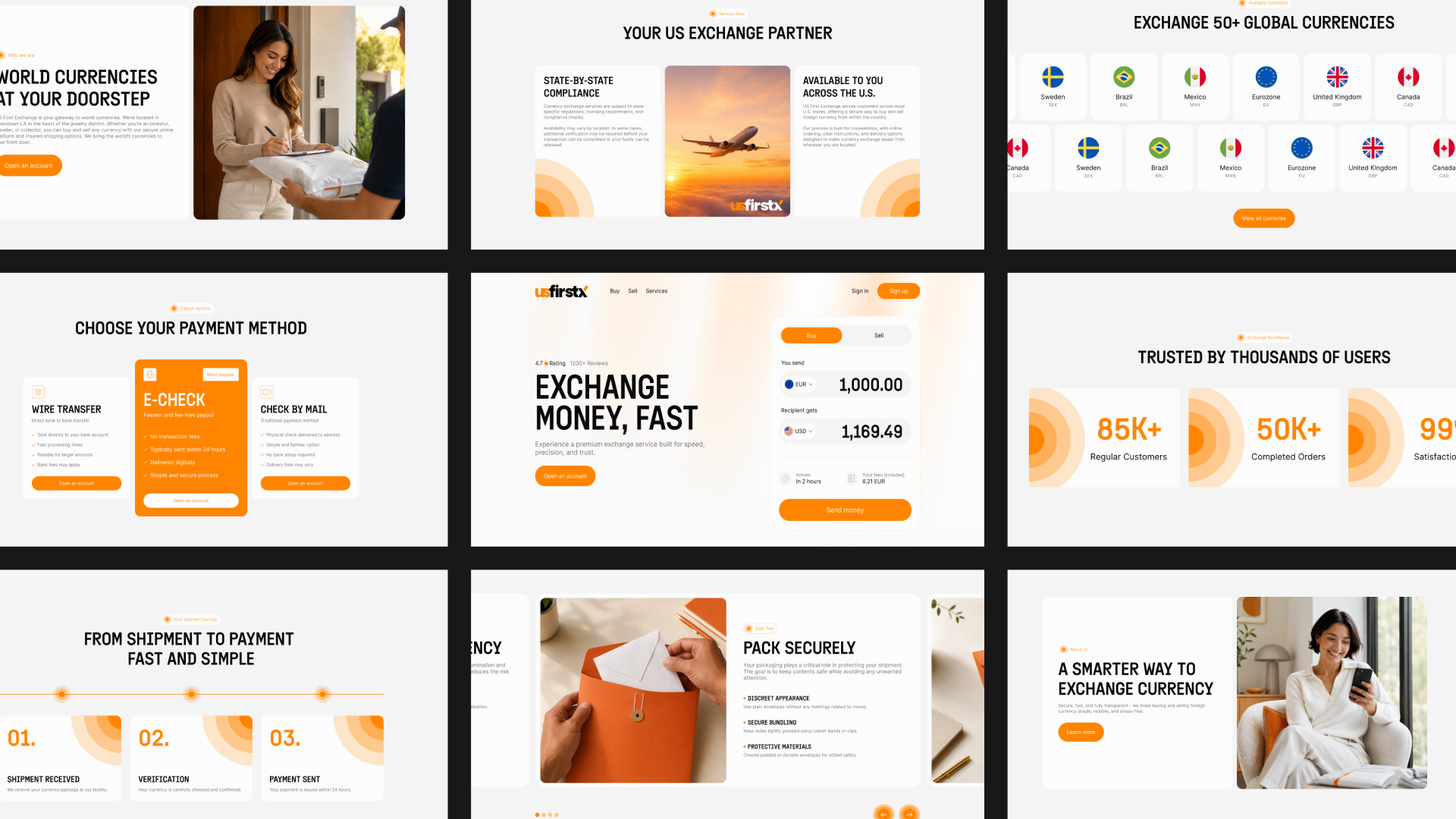
US First Exchange is a currency exchange platform where people buy and sell foreign currency online and have it shipped to their door. It runs on our infrastructure, developed and maintained by our team.
Services
UI & UX Design
Web Development
Industry
Financial Services
Date
In progress
The challenge
Exchanging currency by mail asks a lot of the customer. They have to move through a flow, choose a currency, see a rate, set up the order, arrange shipping, and trust the whole thing with their money. If any step along the way is confusing, people don’t push through. They leave.
That’s what was happening. Too many people started an exchange and abandoned it partway. Every one of those exits is a transaction that almost happened and then didn’t, demand that walked in the door and walked right back out.
The friction had a second cost. The people who did make it through often had questions, and those questions landed on support. A flow that’s hard to follow doesn’t just lose customers; it generates a steady stream of “how does this work?” that ties up the team and slows everything down.

The Solution
We focused on the flow itself. We found the points where people hesitated or dropped off, and we cleared them, fewer dead ends, less confusion, a straighter path from “I want to exchange this” to “it’s done.”
A lot of the support load came from the product not explaining itself. So we let the flow do the explaining. The questions that used to turn into tickets now get answered in the moment, on the screen the customer is already looking at.
The platform runs on AWS, ECS, RDS, S3, DMS, with full CI/CD, on our infrastructure. On top of that cleaner base, we’re now building out a new layer of features, something that’s far easier to do well once the core flow is solid.
The result
Exchanging currency by mail asks a lot of the customer. They have to move through a flow, choose a currency, see a rate, set up the order, arrange shipping, and trust the whole thing with their money. If any step along the way is confusing, people don’t push through. They leave.
That’s what was happening. Too many people started an exchange and abandoned it partway. Every one of those exits is a transaction that almost happened and then didn’t, demand that walked in the door and walked right back out.
The friction had a second cost. The people who did make it through often had questions, and those questions landed on support. A flow that’s hard to follow doesn’t just lose customers; it generates a steady stream of “how does this work?” that ties up the team and slows everything down.

The takeaway
A cleaner flow means people finish more of what they start and ask for help far less often. Remove the friction and everything downstream improves, fewer drop-offs, more completed transactions, and a fraction of the support load.